How Does Streaming TV Advertising Work for Small Businesses?
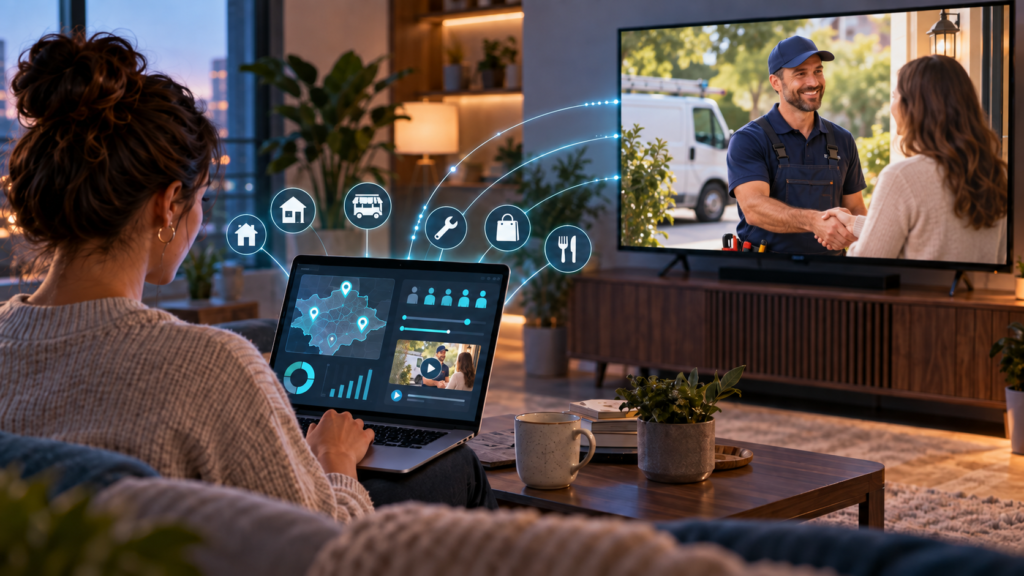
Streaming TV advertising is no longer reserved for national brands with massive media budgets. As viewers continue shifting from traditional cable to services like Hulu, Roku, Tubi, and Pluto TV, small businesses have a new way to reach local customers on the biggest screen in the house. But the terminology, buying process, targeting options, and measurement can make connected TV advertising seem more complicated than it really is.
For business owners considering the channel, the important questions are practical: where ads appear, what campaigns cost, how audiences are selected, and whether results can be connected to actual leads, sales, and revenue.
What is Connected TV, OTT Advertising, and FAST Channels?
The vocabulary sounds harder than the thing it describes. Connected TV means any television connected to the internet. Over-the-top, or OTT, describes content delivered through the internet rather than a cable box. FAST stands for free ad-supported streaming TV, the linear-style channels bundled into most streaming services.
One mechanism, three labels. Your 30-second spot plays the same way under all of them.
Where Your Ad Actually Plays: Hulu, Roku, Tubi, and Pluto TV
Hulu, Peacock, Paramount+, ESPN+, Discovery+, and Prime Video sell ad inventory inside full episodes. Roku, Tubi, Pluto TV, and Sling TV run free ad-supported catalogs and linear channels. The screen is usually a living room set: a Samsung smart TV, an Amazon Fire TV stick, a Chromecast, an Apple TV box, or a gaming console.
Your ad is not buying a show. It is buying a household watching one. That distinction is what makes streaming television affordable for a plumber in three ZIP codes.
Ad-Supported Tiers, AVOD, and Why the Inventory Opened Up to Local Businesses
Every major service launched an ad-supported tier. Netflix did it. Disney did it. AVOD and FAST inventory expanded faster than national advertisers could absorb it, and programmatic buying opened the surplus to local businesses.
Local service providers, franchises, healthcare providers, and real estate agencies now bid on the same premium streaming inventory as national brands.
Put your business on the streaming screens your customers already watch every day
What Are the Benefits of Streaming TV Ads for Small Businesses?
Five things changed for local advertisers. Precision replaced waste, measurement replaced guessing, and the entry price dropped to something a service business can test without a board meeting.
Precision Targeting Without Broadcast Market Waste
A broadcast market ignores your service area. You pay for an entire metro, including the 80% of households that will never drive to your store.
Streaming reverses that. You buy specific ZIP codes, a radius around each location, or a county, and the impressions land only there. For brands running many rooftops, multi-location reporting splits matched revenue and ROAS by store instead of blending it into one average.
Full-Screen Video Ads on Smart TVs With High Completion Rates
A social video competes with a thumb. A streaming spot does not. On premium inventory the ad is full-screen and non-skippable, and completion rates run far above what display ads or social feeds deliver.
Creative quality carries more weight here. A phone-shot clip that works in a feed looks thin on a 65-inch screen.
Flexible Budgets, No Annual Contract, No Monthly Commitment
Broadcast TV ads wanted a monthly commitment and a production budget before anyone discussed results. Streaming does not. With RevTV, you review your campaign pricing before launch, with no subscription and no annual contract.
Start at one market. Scale what works, hold what performs, trim what does not.
Real-Time Reporting Digital Buyers Already Expect
Anyone buying digital advertising already expects a dashboard. Streaming now delivers one. Delivery and frequency update while the campaign runs. Matched results fill in as your sales records come in.
RevTV reports by campaign, creative, channel, audience, and location, so store-level performance reporting sits next to brand totals in one view.
Brand Recall That Makes Search Ads and Direct Mail Work Harder
Streaming works alongside those channels rather than replacing them. Run it with search, direct mail, and social, then compare matched results by channel instead of assuming one lifts the other.
That familiarity compounds. Households exposed to a streaming spot respond better to direct mail, display ads, and social media from the same brand.
Get television-level impact with digital targeting, flexible budgets, and measurable business results
How a CTV Advertising Campaign Gets Built and Bought Through a DSP
A demand-side platform, or DSP, is the software that buys the impression. It bids on behalf of your campaign against targeting rules you set. An SSP sells the publisher’s inventory into that auction, and SSAI stitches the winning ad into the stream before it reaches the viewer.
RevTV handles the logistics inside the platform. Businesses and agencies have the freedom to create, build and launch the campaign, with management help from our experts whenever it is needed.
Targeting Households by ZIP Code, DMA, Income, and Homeowner Status
Household-level targeting replaces channel-level guessing. A dealer group buys a trade area; a dentist buys a radius. Dealership streaming campaigns and single-location service businesses use the same controls:
- ZIP code, county, DMA, or a radius around each location
- Demographics including age, income, and household composition
- Homeowner status, interests, and behavioral data
- First-party data: your own customer list and first-party lists matched to households
- Retargeting households that already visited your site
Creative Specs for a 30-Second Non-Skippable Spot
Most platforms accept a 15- or 30-second spot at 1920×1080, H.264, with normalized audio and closed captions. An existing broadcast spot usually passes with minor edits.
Put the brand in the first five seconds. Viewers watching a full screen still watch with the sound off more often than agencies assume.
Launch premium streaming campaigns without managing complicated ad-buying technology behind the scenes
What Do TV Ads Cost on Streaming Platforms?
Streaming TV ads are priced on CPM, the cost per thousand impressions. A linear TV buy sells you a time slot. Streaming sells you a household, with no production minimum and no rate card negotiated by a media buyer. The variables are targeting depth, inventory quality, and how narrow your geography is.
What Drives CPM Up or Down on Premium Streaming Services
Premium streaming services inside full-episode content carry higher CPMs than open-auction inventory. Live sports carry more again. Narrow geography raises the rate because fewer impressions qualify.
A private marketplace deal or a direct buy costs more than an open auction and delivers cleaner placements. At RevTV, you review the CPM, estimated impressions, and reach before you launch, so the trade is visible while you can still change it.
A Realistic Monthly Budget, Minimum Spend, and Self-Serve Buying
Self-serve platforms killed the old minimum spend. A local advertiser can start with one market and a media spend smaller than a month of paid search, then scale once the numbers hold.
Give any test four to six weeks. One geography, one audience, one clear offer. A campaign paused after nine days has measured nothing.
See exactly what your media budget buys before your streaming campaign ever launches
Measuring Results: From Impressions to Matched Revenue
Here is where streaming TV advertising separates from the rest of the category. Impressions are delivery data. A streaming TV campaign has to report business outcomes, and matched revenue is the one that counts. Most platforms report the first and call the job finished.
Your revenue already sits in a CRM, a point of sale, or a scheduling system. The question is whether anyone connects it.
Why Completion Rate and View-Through Conversions Stop Short
A 97% completion rate tells you the spot played. It does not tell you a single booked job.
View-through conversions get closer by counting site visits and calls after exposure, but raw call volume is not revenue. A phone call is not a signed case. Firms running streaming ads for law firms need the count that survives intake, not the one the dialer reports.
Matchback Attribution: Tying Ad Exposure to Leads, Sales, and ROAS
Matchback attribution compares the households exposed to your campaign against customer records in your own systems, matched on customer-level details such as a service address. When a household that saw your ad later appears in those records, the order, booked job, appointment, or sold unit is reported as matched revenue and ROAS.
RevTV works with records from systems such as ServiceTitan, Toast, Clio, and DMS or POS platforms, and reports cost per booked job by ZIP code, creative, and channel so you can decide what to scale, hold, or trim.
Stop measuring views alone and start connecting advertising spend directly to real revenue
Is Video Advertising on Streaming Right for Your Small Business?
Not for everyone. If you need leads this week at a fixed cost per acquisition, paid search is the faster instrument. Streaming earns its place when brand awareness in a defined geography drives the phone call weeks later.
Considered purchases benefit most. A roofing company, a med spa, auto dealerships, an attorney with a long decision window.
Brand Awareness vs. Leads: Streaming Ads, Search Ads, and Social Media
Search captures demand that already exists. Google Ads harvests it. Streaming ads aim to build the preference that makes the search happen, and brand awareness built on a television screen carries credibility that YouTube pre-roll on a phone cannot borrow.
Run both. Streaming builds familiarity, and search captures demand when it arrives. Whether streaming actually raised your search conversions is a separate question. Answering it takes a holdout test, not matched revenue.
Your First 60 Days: Video Ads for HVAC, Restaurants, and Dental Practices
- Pick one service area and one audience. Do not split a small budget across markets.
- Ship one 30-second spot. Test a second creative only after the first has delivered.
- Connect the system where revenue lands before launch.
- Read results at four weeks by ZIP code and creative, then scale, hold, or trim.
CTV advertising for HVAC tracks cost per booked job. Restaurant and QSR campaigns track same-store sales and new versus returning guests. Streaming ads for dental practices track booked appointments, targeted on location and general audience signals only, never on conditions or treatment history.
Find out whether streaming TV fits your market, customer journey, and growth goals
Launch a Connected TV Ad Campaign With RevTV
RevTV gives businesses and agencies everything they need to build, launch, and manage connected TV campaigns in one self-serve platform. Target by ZIP code, radius, or audience, review campaign pricing before you launch, and get support whenever you need it.
Reporting then connects ad exposure to the leads, sales, and revenue already in your own records, helping you see which households that saw your ad went on to become customers.